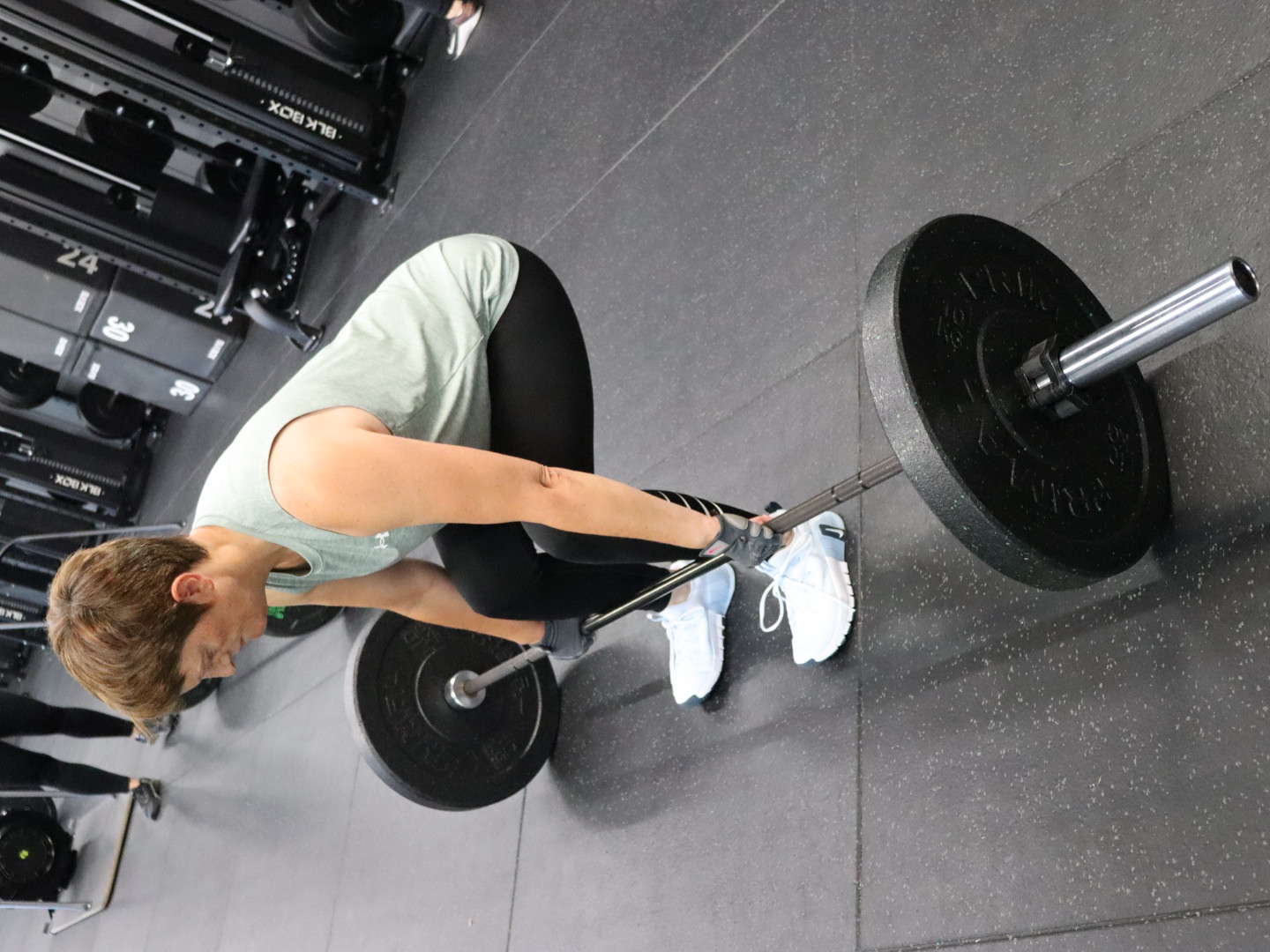
Not sure what weight you should lift? Learn how to choose the right weight, when to increase it and how to progress safely with strength training.
“How do I know what weight I should be lifting?”
There isn’t one perfect weight you should be lifting. The right weight depends on the exercise, your experience, your current strength and how many reps you’re aiming to complete.
Here’s how we approach it at HUSTLE.
The weight should feel manageable at the beginning of your set but increasingly challenging by the last 2 reps. If you're aiming for 10 reps and you finish the 10th feeling like you could comfortably do another 5 or 6, the weight is too light. Equally, if you're aiming for 10 but you're fighting for your life by rep six and your technique has completely changed, it's too heavy.
As a general rule: choose a weight that allows you to perform the prescribed reps with good technique while making the final few reps genuinely challenging.
There's a misconception that a workout only counts if you've pushed every exercise until you physically can't perform another rep. You don't need to do that. Training close to failure can be useful in certain situations, but consistently getting stronger doesn't require every set to become a battle. For most people, particularly those newer to strength training, learning to move well, gradually increasing the weight and being consistent will get you much further than trying to destroy yourself every session.
This sounds obvious, but beginners often compare the numbers they're lifting across completely different exercises. You might use a relatively heavy weight for lower body exercise but a much lighter weight for an upper body exercise. Different movements involve different muscles and require different levels of strength. Instead of worrying about the number written on the dumbbell ask yourself: Is this weight challenging me appropriately for this particular exercise?
Adding weight isn't progress if you can only lift it by completely changing how you perform the exercise. That's why at HUSTLE we coach technique before worrying about how much someone can lift. That doesn't mean your technique has to look absolutely perfect before you're allowed to progress. Movement naturally looks slightly different from person to person. But you should be able to control the weight and perform the exercise safely and effectively. If increasing the weight means your range of movement suddenly changes, you're rushing every rep or you're compensating significantly somewhere else that's usually a sign to reconsider the weight.
Use 8–10 reps as an example. Initially 8 reps with a particular weight might feel challenging. Over the next few weeks you might manage 9, then 10. Once you can do 10 reps for multiple sets that is a good indication it is time to increase the weight. You increase the weight, the reps will drop down and you gradually build up again.
Progress isn't always: 10kg → 12.5kg → 15kg → 17.5kg.
Sometimes progress means doing another repetition with the same weight. Sometimes it's performing the same repetitions with better control. It could be improving your range of movement, feeling more confident with an exercise or completing all your sets with better technique. And sometimes you'll lift less than you did the previous week. Sleep, stress, work, nutrition, illness and general life can all affect how you perform on a particular day. Look at what you're doing over months not individual sessions.
Your first priority is learning the movement and building confidence. Once you understand the exercise you can gradually increase the weight.
At HUSTLE our fully coached personal training sessions help members choose appropriate weights, improve technique and progress over time.
You don't need to walk into the gym already knowing what you're doing.
That's what our coaches are there for.
Check out the 6 Week Kickstart if you need help.
